Quantum Computing’s Impact on AI Cybersecurity: Navigating Future Threats and Defenses
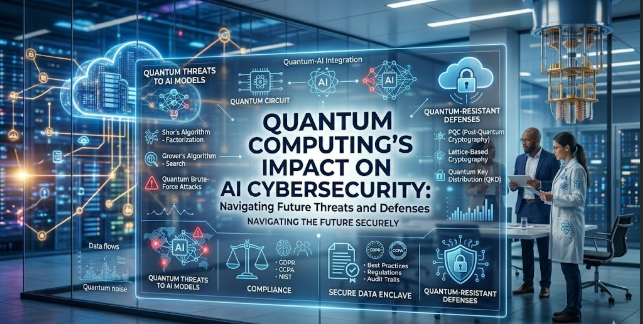
Quantum Computing’s Impact on AI Cybersecurity: Navigating Future Threats and Defenses
The digital world stands on the precipice of a monumental shift. Two revolutionary technologies, quantum computing and artificial intelligence (AI), are rapidly advancing, promising unprecedented capabilities but also posing profound challenges to our established cybersecurity frameworks. This isn’t a distant future; it’s a horizon rapidly approaching, demanding our immediate attention to understand the intricate quantum computing impact on AI cybersecurity.
For decades, the bedrock of secure digital communication and data protection has been public-key cryptography. Algorithms like RSA and elliptic curve cryptography (ECC) secure everything from online banking to classified government communications. These rely on mathematical problems that are computationally infeasible for even the most powerful supercomputers to solve within a practical timeframe. Enter quantum computing, a technology leveraging the bizarre properties of quantum mechanics to process information in fundamentally new ways. With its immense processing power, quantum computing has the potential to shatter these cryptographic foundations, rendering our current digital defenses obsolete.
The Quantum Threat: A Paradigm Shift in Encryption
The primary concern stems from specific quantum algorithms, most notably Shor’s algorithm. Developed by Peter Shor, this algorithm can efficiently factor large numbers and solve discrete logarithm problems – the very mathematical underpinnings of RSA and ECC. While general-purpose, fault-tolerant quantum computers capable of running Shor’s algorithm at scale are still some years away, their eventual arrival is considered by many experts as inevitable.
When these “cryptographically relevant quantum computers” emerge, the implications are staggering. Encrypted data, secure communications, and digital identities would all be vulnerable. Nations, corporations, and individuals face the prospect of their most sensitive information being exposed, not just in the future, but potentially retrospectively through “harvest now, decrypt later” attacks, where encrypted data is stolen today in anticipation of future quantum decryption capabilities.
AI’s Dual Role in a Quantum-Threatened Landscape
As quantum computing reshapes the threat landscape, artificial intelligence emerges as a double-edged sword. AI will undoubtedly be part of both the problem and the solution, profoundly influencing the quantum computing impact on AI cybersecurity.
AI as a Weapon: Enhanced Cyberattack Capabilities
On the offensive front, AI can amplify the capabilities of cybercriminals and state-sponsored actors. Even before quantum computers are fully weaponized, AI-powered tools can:
- Automated Exploit Generation: AI algorithms can rapidly identify vulnerabilities in code, predict potential attack vectors, and even generate sophisticated exploits with minimal human intervention.
- Advanced Social Engineering: Deepfake technology, a product of advanced AI, can create highly convincing audio and video impersonations, making phishing and social engineering attacks virtually undetectable. Imagine a CEO’s voice cloned to authorize a fraudulent transfer.
- Faster Vulnerability Detection: Attackers can leverage AI to scan vast networks and codebases for weaknesses far more efficiently than traditional methods, speeding up the discovery of pre-quantum vulnerabilities.
- Adaptive Malware: AI can create malware that learns and adapts to evade detection, making traditional signature-based security systems less effective.
In a post-quantum world, AI could be instrumental in managing and optimizing quantum attack strategies, potentially making the process of breaking encryption more accessible to a wider range of malicious actors.
AI as a Shield: Defending Against New-Age Threats
Conversely, AI is also our most promising ally in constructing robust defenses against both quantum and pre-quantum threats. Its ability to process massive datasets, identify complex patterns, and make rapid decisions is invaluable for modern cybersecurity.
- Threat Detection and Anomaly Identification: AI and machine learning algorithms excel at spotting unusual patterns in network traffic, user behavior, and system logs that indicate a cyberattack. They can detect novel threats that might bypass traditional rules-based systems.
- Automated Incident Response: When an anomaly is detected, AI can trigger automated responses, such as isolating affected systems, blocking malicious IP addresses, or patching known vulnerabilities, significantly reducing response times.
- AI-driven Post-Quantum Cryptography (PQC) Development: AI can accelerate the research and development of new quantum-resistant cryptographic algorithms. It can analyze the security properties of proposed algorithms, identify potential weaknesses, and optimize their performance.
- Predictive Analytics for Cyber Defense: By analyzing global threat intelligence, AI can predict emerging attack trends and help organizations proactively bolster their defenses before attacks even materialize.
Navigating the Post-Quantum Transition: Strategies for Resilience
The impending quantum threat necessitates a proactive and comprehensive strategy. A core component of this strategy involves a deep understanding of the quantum computing impact on AI cybersecurity and leveraging AI in the transition.
Post-Quantum Cryptography (PQC)
The global cybersecurity community, led by organizations like the U.S. National Institute of Standards and Technology (NIST), is actively developing and standardizing new cryptographic algorithms that are resistant to quantum computer attacks. These Post-Quantum Cryptography (PQC) algorithms are based on different mathematical problems that are believed to be hard even for quantum computers.
The migration to PQC will be a monumental undertaking, requiring a “crypto-agility” mindset – the ability to easily swap out cryptographic modules as new standards emerge. Organizations will need to inventory all their cryptographic assets, understand dependencies, and plan for a phased transition. NIST’s PQC standardization process is a crucial resource for understanding these developments.
AI-Enhanced Cybersecurity Frameworks
Integrating AI more deeply into cybersecurity frameworks will be critical for managing the complexities of a post-quantum world. This includes:
- Zero Trust Architecture: Assuming no user or device can be implicitly trusted, regardless of their location, and requiring strict verification for every access attempt. AI can continuously monitor trust levels and flag suspicious behavior.
- Continuous Monitoring and Adaptive Security: AI systems can provide real-time threat intelligence and adapt security policies dynamically to respond to evolving threats, including those amplified or enabled by quantum capabilities.
- Quantum-Safe Key Distribution (QKD): While distinct from PQC, Quantum Key Distribution offers a theoretically unbreakable method for key exchange using quantum mechanics. AI could play a role in optimizing and securing QKD networks.
The Interplay: Understanding the quantum computing impact on AI cybersecurity
The true challenge and opportunity lie in understanding the profound interplay between these two technologies. The quantum computing impact on AI cybersecurity isn’t just about PQC; it’s about how AI tools will be used by both attackers and defenders in a world where quantum machines can break traditional encryption.
Defensive AI will need to evolve rapidly, learning to identify quantum-accelerated attacks and to help deploy and manage PQC solutions at scale. Attackers will leverage AI to find new vulnerabilities in PQC algorithms or to orchestrate more sophisticated, multi-pronged attacks. The arms race will intensify, but AI’s analytical power gives defenders a fighting chance to stay ahead, provided they invest wisely and proactively.
What Comes Next? Preparing for the Quantum-AI Era
Preparing for this future requires a multi-faceted approach:
- Research and Development: Continued investment in quantum-resistant algorithms, quantum computing itself, and advanced AI for cybersecurity.
- Talent Development: Training a new generation of cybersecurity professionals with expertise in quantum mechanics, advanced cryptography, and artificial intelligence.
- International Collaboration: Sharing knowledge and resources across borders to address a global threat that respects no boundaries.
- Government and Industry Roles: Governments must provide clear guidance and funding, while industries must prioritize quantum-safe transitions in their products and services.
Frequently Asked Questions (FAQ)
Q1: Will quantum computers break all encryption immediately?
A: Not immediately. While Shor’s algorithm can break asymmetric encryption (like RSA and ECC), symmetric encryption (like AES) is believed to be more resistant, though its key lengths will likely need to be doubled. The development of fault-tolerant quantum computers capable of these attacks is still years away, but the threat is real and requires proactive preparation.
Q2: What is Post-Quantum Cryptography (PQC)?
A: Post-Quantum Cryptography (PQC) refers to new cryptographic algorithms designed to be secure against attacks from both classical and quantum computers. These algorithms are based on different mathematical problems than current standards and are being standardized by bodies like NIST.
Q3: How will AI help in cybersecurity against quantum threats?
A: AI can assist by rapidly developing and testing new PQC algorithms, identifying and responding to quantum-accelerated attacks, automating security operations, and predicting future threat vectors. It will be crucial for managing the complexity of the post-quantum transition.
Q4: Are there any current cybersecurity solutions that are “quantum-proof”?
A: “Quantum-proof” is a strong term, but Post-Quantum Cryptography (PQC) algorithms are being developed specifically to be resistant to known quantum attacks. Quantum Key Distribution (QKD) offers theoretically unconditional security for key exchange but is not a full cryptographic solution on its own and has practical limitations. Most current systems are not quantum-safe.
Q5: Should individuals be worried about their personal data now?
A: While the immediate threat to personal data from quantum computers isn’t imminent, the “harvest now, decrypt later” scenario means that data encrypted today could be vulnerable in the future. Organizations handling sensitive data are actively planning for this transition, and awareness is key.
The convergence of quantum computing and artificial intelligence heralds a new era for cybersecurity. While the threats are profound, the opportunity to build more resilient and intelligent defense mechanisms is equally significant. By understanding the evolving landscape and making strategic investments in PQC, AI-powered defenses, and skilled talent, we can navigate this complex future and safeguard our digital world.
Category: CYBERSECURITY
Tags: quantum computing, cybersecurity, artificial intelligence, encryption, post-quantum cryptography, cyber threats, AI in security, future tech