


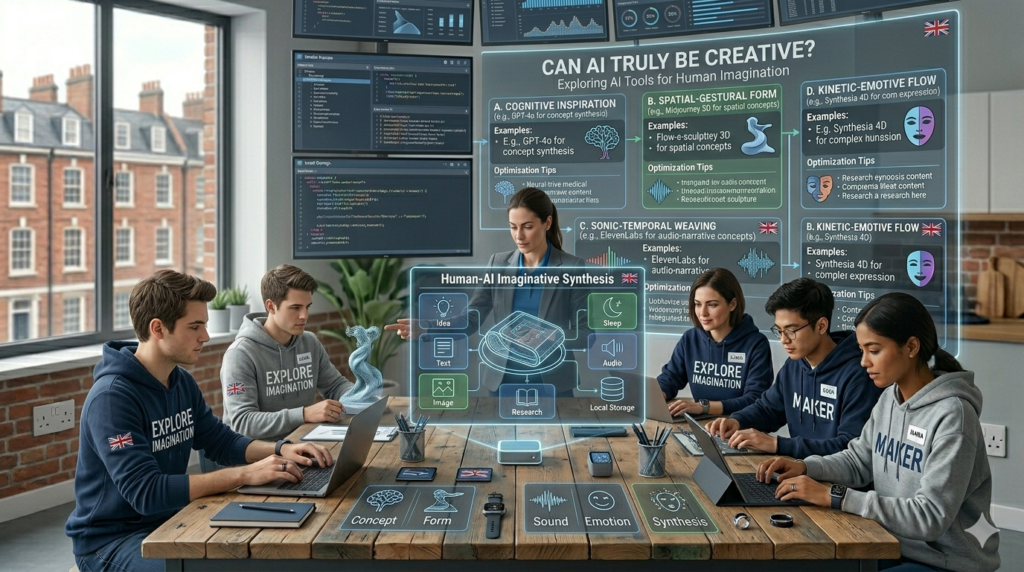
Can AI Truly Be Creative? Exploring AI Tools for Human Imagination
For millennia, creativity has been considered the quintessential human trait – a spark of genius, an intuitive leap, the ability to conjure something entirely new from the ether. Yet, in our rapidly evolving digital age, artificial intelligence (AI) has begun to tread into territories once thought exclusively human. From composing symphonies to drafting novels and generating stunning visual art, AI’s capabilities are expanding at an astonishing rate. This raises a profound question: Can AI truly be creative, or is it merely an advanced mimic, a sophisticated algorithm reflecting patterns? More importantly, how can we leverage ai tools for creative thinking to amplify, rather than diminish, our own imaginative potential?
Defining Creativity: A Human Prerogative?
Before we attribute creativity to machines, it’s crucial to understand what we mean by the term itself. Human creativity is often characterized by several key elements: originality (producing something novel), utility or value (the creation serves a purpose or evokes emotion), and intentionality (the creator has a conscious goal or message). It’s deeply intertwined with our lived experiences, emotions, cultural contexts, and even our subconscious minds. Our ability to connect disparate ideas, to empathize, to express complex feelings – these are traditionally seen as the bedrock of genuine human innovation. An artist doesn’t just combine colors; they imbue their work with personal history, societal commentary, or a profound emotional landscape.
The Dawn of Algorithmic Inspiration: How AI Generates
AI, particularly generative AI, operates on a fundamentally different principle. It doesn’t “feel” or “intend” in the human sense. Instead, these sophisticated systems are trained on vast datasets of existing human creations – millions of images, texts, musical pieces. They learn the underlying patterns, structures, and stylistic elements within this data. When prompted, an AI algorithm doesn’t imagine a new concept; it applies complex mathematical models to generate outputs that statistically resemble and combine elements from its training data in novel ways.
Beyond Imitation: The Nuance of AI-Assisted Creation
While early AI art might have felt like clever pastiche, modern generative AI goes far beyond simple imitation. Tools like large language models (LLMs) can weave intricate narratives, write compelling ad copy, or even draft poetic verses with remarkable coherence. Image generators can render photorealistic scenes or abstract concepts that never existed. This isn’t just regurgitation; it’s a recombination and transformation of learned patterns into something statistically “new.” The nuance lies in recognizing that while the process is algorithmic, the output can be genuinely surprising and inspire human creators.
AI Tools for Creative Thinking: A Catalyst for Human Imagination
The true power of AI in the creative realm isn’t in its capacity to replace human ingenuity, but in its ability to serve as an unparalleled catalyst. AI tools for creative thinking are rapidly becoming indispensable assistants, allowing artists, writers, designers, and musicians to explore new avenues, overcome creative blocks, and accelerate their workflow.
- Idea Generation & Brainstorming: Stuck on a headline, a plot twist, or a marketing slogan? AI writing assistants can suggest dozens of variations in seconds. Tools like advanced chatbots can act as brainstorming partners, prompting you with unexpected questions or offering entirely new perspectives you might not have considered. Imagine asking an AI for “20 metaphors for a struggling startup” or “plot ideas for a dystopian novel set in a library.”
- Visual Arts & Design: For visual creators, AI image generators are revolutionizing the landscape. Artists can quickly generate concept art, experiment with different styles, or create intricate textures and backgrounds that would take hours manually. Designers can use AI for rapid prototyping, generating multiple logo variations, or even optimizing layouts for user experience. Whether you’re a painter using AI for compositional inspiration or a graphic designer needing unique stock imagery, these tools open vast possibilities.
- Music Composition & Production: Musicians are employing AI to generate melodies, harmonies, and even full instrumental tracks. AI can analyze your existing compositions and suggest complementary elements, or it can create entirely new pieces based on specific moods or genres. This frees up human composers to focus on the emotional depth and unique artistic vision.
- Writing & Content Creation: Beyond just idea generation, AI writing tools are transforming the content landscape. They can assist with drafting articles, summarizing complex texts, improving grammar and style, and even optimizing content for SEO. While the human touch remains essential for authenticity and unique voice, AI streamlines the often-laborious initial stages of writing.
These tools don’t do the creative thinking for you; they provide an expanded palette, a larger canvas, or a faster brush. They reduce the friction between an idea forming in your mind and its manifestation in the physical or digital world.
Overcoming Creative Blocks with AI
One of the most valuable applications of AI in creativity is its potential to dismantle creative blocks. Every artist experiences moments where inspiration wanes, or they hit a conceptual wall. AI can offer a fresh perspective by generating unexpected combinations, presenting alternative directions, or simply providing a starting point. A writer struggling with character development might use AI to generate backstories; a designer stuck on a color scheme might ask an AI for “vibrant palettes inspired by autumn leaves.” AI serves as a neutral, tireless sounding board, capable of endless permutations until a spark reignites.
The Human-AI Collaboration: A New Creative Paradigm
The most compelling future for creativity isn’t a battle between human and machine, but a partnership. AI functions best as a co-pilot, a sophisticated assistant that extends human capabilities rather than diminishes them. The human provides the intention, the emotional depth, the nuanced understanding of culture and context, and the ultimate judgment of what constitutes “good” or “meaningful.” AI provides the speed, the computational power, the ability to process vast amounts of data, and to generate an almost infinite array of possibilities.
This collaboration allows humans to focus on the higher-order creative tasks – conceptualization, emotional resonance, storytelling, and injecting unique artistic voice – while AI handles the more repetitive, data-intensive, or exploratory elements. It’s a symbiotic relationship where human intuition guides algorithmic execution, leading to outcomes that neither could achieve alone.
Ethical Considerations and the Future of Authorship
As AI’s role in creative fields grows, so do important ethical and philosophical questions. Issues of originality, copyright, and authorship become complex. If an AI generates an image based on a human prompt, who is the “artist”? If an AI helps write a novel, does it share the credit? These are questions society and legal frameworks are just beginning to grapple with. Transparency about AI’s involvement, clear guidelines for usage, and a renewed emphasis on human intent and curation will be crucial as this new creative paradigm evolves.
FAQs about AI and Creativity
Here are some common questions about the intersection of artificial intelligence and human imagination:
- Is AI creativity “real” creativity? AI’s creative process is fundamentally different from humans’. It processes data and generates novel combinations based on learned patterns, lacking human consciousness, emotion, or intent. While the output can be novel and inspiring, most experts distinguish it from genuine human creativity, which is deeply rooted in lived experience and subjective understanding. It’s more accurately described as algorithmic generation or assisted creativity.
- Will AI replace human artists, writers, or musicians? Highly unlikely in its entirety. AI is an excellent tool for augmentation, automation of mundane tasks, and idea generation. However, the unique human capacity for empathy, personal storytelling, cultural nuance, and emotional expression remains irreplaceable. AI will likely change how creative professionals work, freeing them to focus on higher-level conceptual tasks.
- What are some common AI tools for creative thinking? Many tools assist various creative tasks. For writing, there are AI assistants for drafting and editing (e.g., GPT-powered tools). For visual art, tools like Midjourney or DALL-E generate images from text prompts. For music, platforms like AIVA can compose original pieces. Many graphic design suites also integrate AI features.
- How can I start using AI in my creative process? Begin by identifying repetitive or block-prone aspects of your work. For writers, try using AI to brainstorm headlines or outline articles. For designers, experiment with AI image generation for mood boards or concept art. Many AI tools offer free trials, making it easy to explore their potential without commitment.
- Is AI-generated content ethical to use? The ethics depend on the context and transparency. For personal exploration and concept generation, it’s widely accepted. For published works, disclosing AI involvement is often considered ethical and good practice. Be mindful of potential biases in training data and ensure your use of AI aligns with copyright laws and your own artistic integrity.
The journey into the nexus of artificial intelligence and human imagination reveals not a zero-sum game, but a profound opportunity. AI, particularly effective ai tools for creative thinking, are not here to usurp our inherent imaginative abilities. Instead, they serve as powerful extensions of our minds, offering new perspectives, accelerating processes, and helping us overcome obstacles. By embracing AI as a collaborative partner, human creators can unlock unprecedented levels of innovation, pushing the boundaries of what’s possible and enriching the tapestry of human expression in ways we are only just beginning to comprehend. The future of creativity is not about humans versus machines; it’s about humans with machines, forging a path towards an even more imaginative tomorrow.
Category: AI & AUTOMATION
Tags: AI creativity, ai tools for creative thinking, human imagination, generative AI, creative AI, future of creativity, AI innovation, digital art