


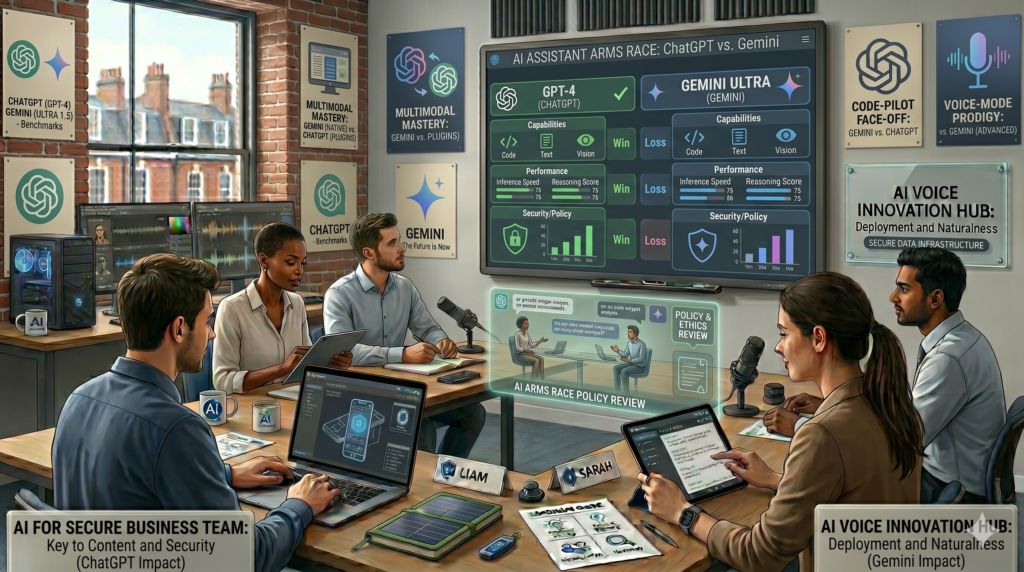
A silent, yet seismic, shift is underway in the technology landscape. It’s an escalating rivalry between two artificial intelligence titans: OpenAI’s ChatGPT and Google’s Gemini. This isn’t just a corporate battle for market share; it’s a profound AI assistant arms race that reshapes how we interact with information, automate tasks, and even understand the world. But what does this intense competition truly mean for you, the everyday user?
Understanding the implications of this technological duel goes beyond recognizing brand names. It delves into the rapid evolution of capabilities, the ethical considerations, and the very real benefits and challenges that land directly at your fingertips. From streamlining your workday to revolutionizing creative endeavors, the choices made by these companies directly influence your digital future.
The Titans Clash: ChatGPT’s Dominance Meets Gemini’s Ambition
For many, the world of generative AI exploded into public consciousness with the launch of ChatGPT. OpenAI, a research organization, democratized access to sophisticated language models, showcasing their ability to write essays, generate code, and engage in surprisingly human-like conversation. Its rapid adoption underscored a massive public appetite for intelligent digital companions, establishing ChatGPT as an early, dominant player.
Then came Gemini. Developed by Google, a company synonymous with organizing the world’s information, Gemini arrived with immense backing and a promise of multimodal capabilities – adept at understanding and generating text, images, audio, and video from its inception. Positioned as a direct challenger, Gemini leverages Google’s vast data resources, research prowess, and existing ecosystem integration, setting the stage for an unprecedented technological showdown.
This isn’t merely a race for who can build a ‘smarter’ AI. It’s a strategic maneuver for influence over the next generation of computing, where AI assistants transition from novelties to indispensable tools integrated into nearly every aspect of our digital lives.
Driving Forces Behind the AI Assistant Arms Race
Several critical factors fuel this intense competition:
- Technological Breakthroughs: Advances in neural networks, particularly transformer architectures, have made these powerful AI models possible. The race is to continuously refine these models, making them more efficient, accurate, and capable of complex reasoning.
- Data Superiority: The quality and quantity of data used to train these models are paramount. Google, with its vast web index and user interactions, possesses an unparalleled data advantage, while OpenAI continues to innovate with proprietary datasets and strategic partnerships.
- User Adoption and Ecosystem Lock-in: Gaining a critical mass of users is vital. The more people who integrate an AI assistant into their workflow, the harder it becomes to switch. This drives companies to offer compelling features, seamless integrations, and intuitive user experiences.
- Enterprise Applications: Beyond individual users, the enterprise market represents a colossal opportunity. Businesses seek AI solutions for customer service, content generation, data analysis, and software development. The AI assistant competition extends heavily into securing these lucrative commercial contracts.
- Ethical AI and Safety: As AI becomes more powerful, concerns about bias, misinformation, and misuse grow. Companies are under increasing pressure to develop ‘responsible AI’ – models that are safe, fair, and transparent. Success in this area can build crucial trust and differentiate platforms.
The User’s Perspective: Benefits of Fierce Competition
For you, the user, this competitive environment is largely a boon. Here’s how you stand to benefit:
Enhanced Features and Capabilities
The pressure to outdo each other means rapid innovation. We’re seeing:
- Multimodality: AI assistants are evolving beyond text to understand and generate images, audio, and video. Imagine asking your AI to summarize a video, then generate a caption for it, or even create a short animation based on your prompt.
- Improved Accuracy and Reasoning: As models become more sophisticated, their ability to provide factual information, solve complex problems, and engage in logical reasoning improves, reducing instances of ‘hallucination’ or nonsensical outputs.
- Personalization: Both platforms are striving to offer more personalized experiences, learning from your preferences and context to provide more relevant and helpful responses over time.
Increased Accessibility and Affordability
Competition often drives down costs and expands access. While premium versions offer advanced features, basic versions of these AI tools are often free or available at competitive prices, making powerful AI accessible to a broader audience.
Specialized Tools and Integrations
The rivalry fosters a rich ecosystem of third-party tools and integrations. Developers are creating plugins and extensions that connect these AI assistants to a myriad of other services, from productivity apps to creative suites, expanding their utility exponentially.
Faster Innovation Cycle
Companies are compelled to iterate quickly, releasing updates and new features at a breakneck pace. This means that what seems cutting-edge today might be standard tomorrow, continuously raising the bar for what an AI assistant can achieve.
Navigating the Challenges: Potential Pitfalls for Users
While the benefits are clear, this rapid evolution also presents challenges that users must navigate consciously.
Information Overload and Choice Paralysis
With multiple powerful AI assistants and a growing array of specialized AI tools, choosing the right one for a specific task can become overwhelming. Understanding the nuances of each platform’s strengths and weaknesses requires effort.
Bias and Hallucinations
Despite improvements, AI models are trained on vast datasets that can contain inherent biases, leading to outputs that may be unfair, prejudiced, or simply incorrect. Critically evaluating AI-generated content remains crucial.
Privacy Concerns and Data Security
Interacting with AI assistants often involves sharing personal information or proprietary data. Users must be aware of how their data is collected, stored, and used by these companies, and understand the privacy policies before engaging with the tools. The more integrated AI becomes, the more sensitive the data it handles.
The Digital Divide
Access to advanced AI tools often requires modern hardware, reliable internet, and a certain level of digital literacy. This could exacerbate existing inequalities, creating a gap between those who can harness the power of AI and those who cannot.
Skills Gap and Job Displacement
As AI automates more tasks, there’s a legitimate concern about job displacement and the need for individuals to adapt and acquire new skills. Understanding how to collaborate with AI and leverage its capabilities will become an essential skill in many professions.
What the Future Holds: Beyond the Current Duel
The current AI assistant competition user impact is just the beginning. The next phase will likely involve:
- Hyper-Personalization: AI assistants will become far more attuned to individual users, acting as truly intelligent, proactive agents rather than mere query responders.
- Ubiquitous Integration: AI will seamlessly embed into more devices and software, moving beyond dedicated chat interfaces to become an invisible layer across our digital ecosystem.
- Regulatory Scrutiny: Governments worldwide will increasingly focus on regulating AI, particularly concerning data privacy, intellectual property, and ethical usage, influencing how these technologies are developed and deployed.
- Emergence of Niche AIs: While generalist AI assistants will continue to grow, we’ll also see a proliferation of highly specialized AIs designed for specific industries or complex tasks.
The AI assistant arms race is not a static event; it’s a dynamic, accelerating process. For you, the user, it promises unparalleled innovation and convenience, but also demands informed engagement and a critical perspective. Understanding these tools, their capabilities, and their limitations will be key to thriving in the AI-powered future.
Frequently Asked Questions (FAQ) about AI Assistant Competition
Is ChatGPT or Gemini better?
Neither ChatGPT nor Gemini can be definitively declared ‘better’ across the board; it largely depends on the specific task. ChatGPT excels in creative writing, nuanced conversation, and code generation. Gemini, particularly its more advanced versions, often demonstrates superior performance in multimodal understanding (processing images and video alongside text) and integration within the Google ecosystem. Many users find value in experimenting with both to leverage their respective strengths.
How does this competition affect my data privacy?
The competition pushes companies to differentiate on features, but also on trust and security. While both OpenAI and Google have robust privacy policies, the increased use of these AI assistants means more of your interactions and data are processed by these companies. It’s crucial to review the privacy settings and policies of each platform you use, understand what data is collected, and how it might be used to train future models or personalize services. Opting out of data sharing for model training, where available, can enhance your privacy.
Will AI assistants like ChatGPT and Gemini replace human jobs?
The impact of AI assistants on jobs is complex. While they can automate repetitive, data-intensive tasks, they are more likely to augment human capabilities rather than fully replace them. Jobs requiring creativity, critical thinking, emotional intelligence, and complex problem-solving that AI cannot replicate will remain vital. Many roles may evolve, requiring workers to collaborate with AI tools, shifting the focus towards higher-level strategic and interpersonal skills.
How can I choose the best AI assistant for my needs?
To choose the best AI assistant, consider your primary uses. For creative writing, brainstorming, or coding, ChatGPT might be an excellent choice. For tasks involving image analysis, summarising web content, or integrating with Google apps, Gemini could be more suitable. Try the free versions of both ChatGPT and Gemini to evaluate their interfaces and capabilities firsthand, and don’t hesitate to use specialized AI tools for niche requirements.
Category: AI & AUTOMATION
Tags: ChatGPT, Gemini AI, AI Assistants, AI Competition, User Impact, Generative AI, Artificial Intelligence, Tech Trends