Prompt Engineering Guide: Master AI for Superior Content Creation
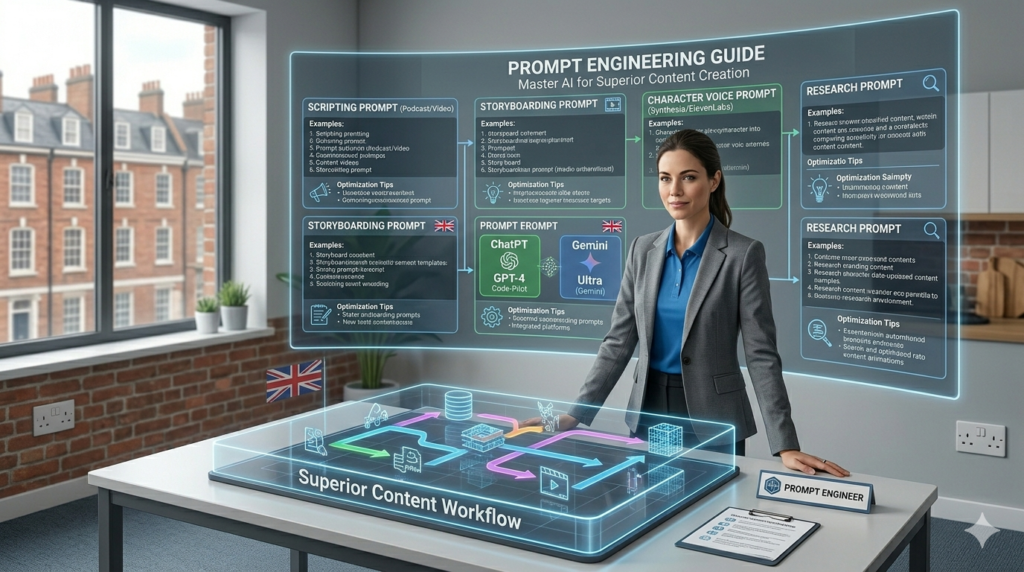
Prompt Engineering Guide: Master AI for Superior Content Creation
The landscape of content creation has been irrevocably changed by artificial intelligence. AI tools, from large language models to image generators, offer unprecedented speed and scale. Yet, the true power of these machines isn’t in their existence, but in your ability to direct them. This is where prompt engineering enters the picture: the critical skill that separates generic AI outputs from truly exceptional, tailored content.
For content creators, prompt engineering is more than a technical trick; it’s the art and science of communicating effectively with AI. It’s about transforming vague ideas into precise instructions, ensuring that the AI understands your intent and delivers high-quality, relevant, and engaging material. Mastering this skill isn’t just about efficiency; it’s about maintaining creative control and pushing the boundaries of what AI can achieve for your audience.
What is Prompt Engineering?
At its core, prompt engineering is the discipline of crafting inputs (prompts) for AI models to achieve desired outputs. Think of it as learning the AI’s language. Just as a chef needs a clear recipe to create a specific dish, an AI model needs a well-structured prompt to generate content that aligns with your vision. It involves understanding how AI processes information, interprets instructions, and generates responses, then using that understanding to guide its behavior.
For content creators, this translates to generating blog posts, social media updates, video scripts, marketing copy, or even image concepts that are not only grammatically correct but also contextually appropriate, on-brand, and compelling. It’s about moving beyond simple queries to strategic communication that leverages the AI’s vast knowledge base and creative capabilities effectively.
Why Prompt Engineering Matters for Content Creators
The stakes for content creators are high. In an increasingly crowded digital space, generic content fades into the background. Prompt engineering offers several distinct advantages:
- Precision and Relevance: No more sifting through irrelevant AI-generated text. Precise prompts yield content that directly addresses your topic, audience, and objectives.
- Time and Cost Efficiency: Reduce the need for extensive editing and revision cycles. Better prompts mean fewer iterations and faster content delivery.
- Enhanced Quality: Elevate the sophistication, nuance, and originality of your AI-assisted content, making it indistrutable from human-written work.
- Creative Expansion: Use AI as a brainstorming partner, generating unique angles, headlines, or content formats that you might not have considered.
- Brand Consistency: Guide AI to adopt specific tones, styles, and brand voices, ensuring all generated content aligns with your brand identity.
The Core Principles of Effective Prompt Engineering
Successful prompt engineering isn’t magic; it’s a systematic approach. By adhering to a few core principles, you can significantly improve the quality of your AI outputs.
Clarity and Specificity
Ambiguity is the enemy of good AI output. Be explicit about what you want. Instead of saying, “Write about social media,” try: “Write a 500-word blog post targeting small business owners, explaining how Instagram Reels can boost their engagement. Focus on actionable tips for creating short, engaging videos. Use a helpful, encouraging tone.”
Specify:
- Topic: What exactly should the content be about?
- Audience: Who are you writing for? (e.g., beginners, experts, parents)
- Format: Is it a blog post, tweet, email, script?
- Length: Word count, paragraph count, number of bullet points.
- Keywords: Key terms to include for SEO or topic focus.
Context is King
Provide the AI with all necessary background information. If you’re writing a follow-up to a previous article, mention it. If there’s a particular style guide, share relevant rules. The more context you provide, the better the AI can tailor its response.
Consider:
- Preceding information: “Building on our previous article about ‘The Basics of SEO’, write a blog post discussing advanced link-building strategies.”
- Persona: “You are a seasoned financial advisor writing to new investors.”
- Purpose: “The goal of this content is to persuade readers to sign up for our newsletter.”
Iteration and Refinement
Rarely will your first prompt yield a perfect result. Prompt engineering is an iterative process. View your initial output as a starting point. Analyze what worked and what didn’t, then refine your prompt based on the discrepancies.
- Evaluate: Does the output meet your criteria? Is the tone correct? Is it accurate?
- Adjust: Add more constraints, remove ambiguity, ask for specific changes. “That was good, but make the tone more playful and add a call to action at the end.”
Constraints and Format
Guide the AI by setting boundaries and specifying the desired structure. This helps prevent irrelevant tangents and ensures the content is delivered in a usable format.
- Length limits: “Keep the response under 200 words.”
- Structure: “Use H2 headings for each tip and conclude with a summary.” “Provide three distinct examples in a bulleted list.”
- Keywords: “Ensure the phrase ‘sustainable marketing practices’ appears at least twice.”
Ethical Considerations and Fact-Checking
Even with excellent prompts, AI can sometimes “hallucinate” or produce biased information. Always fact-check AI-generated content, especially for sensitive topics, statistics, or expert claims. Responsible prompt engineering includes a commitment to accuracy and ethical content creation.
Advanced Prompt Engineering Techniques
Once you’ve mastered the basics, explore these techniques to unlock even more sophisticated outputs.
Persona-Based Prompting
Assign a role to the AI. This helps it adopt a specific tone and perspective. For example: “Act as a senior software engineer explaining complex algorithms to a non-technical marketing team.” or “You are a cheerful travel blogger sharing tips for budget travel.”
Few-Shot Prompting
Provide the AI with examples of desired input/output pairs within your prompt. This helps it understand the pattern you’re looking for. For instance, if you want specific product descriptions, provide one or two examples of how they should be structured and phrased, then ask it to generate more.
Chain-of-Thought Prompting
Encourage the AI to “think step-by-step” before providing a final answer. This can improve the quality of complex reasoning tasks. For example: “Think step-by-step to outline a content strategy for a new B2B SaaS product targeting enterprise clients, then present the final strategy.”
Role-Playing and Scenarios
Set up a dialogue or a hypothetical scenario. “Simulate a customer support interaction where a user is frustrated with a software bug. Draft five different responses aiming to de-escalate the situation.”
Tools and Resources for Prompt Engineering
Various AI models are available, each with its strengths. Experiment to find what works best for your specific content needs.
- Large Language Models (LLMs):
- OpenAI’s ChatGPT: Excellent for a wide range of text generation tasks, from articles to code.
- Google’s Gemini (formerly Bard): Often strong in summarizing information and connecting to real-time data.
- Anthropic’s Claude: Known for its strong performance in complex reasoning and longer contexts.
- Image Generation AI:
- Midjourney: Generates high-quality, artistic images from text prompts.
- DALL-E 2: Another powerful tool for creating images and art from natural language.
- Prompt Libraries & Communities: Explore platforms like PromptBase (https://promptbase.com/) or various Discord communities dedicated to AI art and writing for inspiration and shared prompt examples.
Common Pitfalls and How to Avoid Them
- Vague Instructions: Always be specific. Avoid “write something good.”
- Over-Constraining: While specificity is good, too many rigid constraints can stifle creativity. Find a balance.
- Ignoring Iteration: Don’t expect perfection on the first try. Plan for refinement.
- Lack of Context: Without background, AI guesses. Provide necessary information.
- Unrealistic Expectations: AI is a tool, not a replacement for human creativity and judgment. It augments, it doesn’t automate critical thinking.
Frequently Asked Questions about Prompt Engineering
What’s the biggest mistake beginners make in prompt engineering?
The most common mistake is providing overly vague or generic prompts. Beginners often treat AI like a search engine instead of a collaborative partner. Failing to specify the audience, tone, format, or desired outcome leads to generic and unusable content.
Can prompt engineering help with SEO for my content?
Absolutely. By explicitly including target keywords, asking for specific SEO elements like meta descriptions or heading structures, and requesting content that answers common user queries, prompt engineering directly supports SEO efforts. It helps ensure the AI generates content that is both helpful to readers and optimized for search engines.
How often should I refine my prompts?
Prompt refinement should be an ongoing process. You should refine a prompt whenever the AI’s output isn’t meeting your expectations. Keep a record of successful prompts and iterate on less successful ones. As AI models evolve and your content goals change, your prompts should adapt accordingly.
Is prompt engineering a ‘future-proof’ skill for content creators?
While AI technology is rapidly advancing and user interfaces may simplify, the underlying need to communicate precise intent to machines will remain. The ability to structure information, provide context, and guide AI towards specific outcomes is a fundamental skill that will continue to be valuable, even as tools evolve. It’s about strategic thinking, not just memorizing commands.
Mastering prompt engineering isn’t about becoming a coder; it’s about becoming a better communicator with machines. For content creators, this skill transforms AI from a novelty into an indispensable strategic asset. By applying clarity, context, and iterative refinement, you can direct AI to produce content that is not only efficient but also aligns perfectly with your creative vision and business objectives. Start experimenting, learning, and refining your prompts today – the future of content creation is in your hands.
Category: AI & AUTOMATION
Tags: prompt engineering, AI content creation, generative AI, content marketing, AI tools, digital strategy, writing with AI, content optimization